

How Shade Sail Posts and Anchoring Systems Support Long-Term Performance
A tensile shade system is only as reliable as the structure holding it in place. When people first evaluate a shade installation, their attention often goes straight to the membrane itself, but the long-term success of the project depends just as much on the support system beneath it. At Tensoshade™, shade sail installation is approached as a structural process from the beginning, with careful planning around load transfer, membrane geometry, and anchoring conditions. That is especially important in permanent architectural shade systems where performance must be maintained over time rather than for a single season.
Why Support Systems Matter:
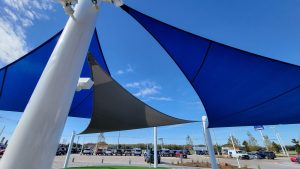
Properly engineered shade sail posts do more than hold the membrane at the right height. They absorb and transfer the forces created by tension, span, and environmental exposure. A shade sail and posts system must be designed to work as one coordinated assembly, not as separate parts brought together at the end of the project. If the support conditions are not engineered correctly, even a well-fabricated membrane can lose shape, experience uneven loading, or require premature adjustment.
Load Transfer and Membrane Stability:
Mounting shade sails requires more than finding convenient attachment points. The support geometry influences how the membrane behaves under tension, how loads move through the system, and how the installation will age under repeated exposure to sun, wind, and rain. Putting up shade sails without structural planning can lead to sagging edges, uneven stress concentrations, or drainage problems that reduce long-term performance. At Tensoshade™, the relationship between membrane form and anchoring strategy is addressed early so the finished system performs as intended.
Structural Planning and Site Coordination:
Every site presents its own constraints. A project may require free-standing posts, building-mounted hardware, or a combination of both. Circulation paths, views, setbacks, and architectural lines all influence where the support system can be located. That is why shade sail installation becomes part of the larger design process rather than a separate final step. A well-positioned post can preserve openness, protect movement through the space, and strengthen the visual composition of the installation.
Fabrication Compatibility:
Support systems also have to align with the membrane that is being fabricated. Span lengths, corner angles, and tensioning hardware must all be coordinated so the membrane maintains proper curvature. The support structure and the membrane are not independent decisions. They are two parts of the same structural system.
Long-Term Performance:
Because architectural shade systems are expected to perform over time, anchoring decisions affect maintenance, tension retention, and structural reliability. Properly engineered shade sail posts help the membrane stay stable, support drainage, and preserve the clean visual lines that define tensile architecture.
Conclusion:
A permanent tensile installation depends on more than fabric alone. When shade sail posts and shade sail and posts assemblies are engineered correctly, they provide the structural foundation that allows the entire system to perform with durability, stability, and architectural clarity over the long term.